
The Cost of Delay: Life Along Nepal’s Daunne Road Section
Author:
Anima Singh
Road infrastructure is typically considered as a symbol of development and economic prosperity. In Nepal, national highway expansion projects are intended to enhance connectivity, shorten travel time, and boost trade and tourism. However, the development projects can create new hardships instead of solving existing problems, when they face repeated delays, weak coordination, and poor monitoring.
The Daunne road section along the Narayanghat–Butwal highway shows a clear example where delayed construction has created long-term challenges for travelers, local communities, and governance systems. For many travelers in Nepal, crossing the Daunne road section is no longer just part of a journey, it is an unpredictable challenge that can take hours, test patience, and sometimes even risk lives. What was once expected to be a symbol of progress has instead become a daily reminder of delayed development. The delays have not only disrupted daily mobility but have also exposed deeper coordination, planning, and accountability challenges within Nepal’s federal development structure.
The Repeated Construction Delays
The Government of Nepal signed a contract with China State Engineering Construction Corporation Limited on December 19, 2018, for the expansion of the Narayanghat–Butwal road, with an expected completion timeline of 42 months. However, the project has faced repeated delays, requiring multiple deadline extensions. In July, the Department of Roads granted a fourth extension, setting new final deadlines of July 21, 2026, for the western segment and July 23, 2026, for the eastern segment. Overall progress of the Narayanghat–Butwal road project has reached around 74%, but the most technically challenging Daunne stretch has achieved only about 50% completion, raising concerns about project planning, contractor performance, and institutional coordination (Sharma, 2025).
The original timelines appear to be unrealistic, particularly due to the the complexity of the Daunne hill section terrain. Delays were further exacerbated by administrative hurdles: site clearance was not completed on time, tree-cutting permits were delayed, relocation of electricity infrastructure took longer than expected, and contractors faced difficulties obtaining construction materials due to extraction restrictions imposed by local governments (Karki, 2025). These issues highlight weak coordination between the Department of Roads, local authorities, and contractors. Although Nepal’s public procurement framework includes provisions for penalties such as contract termination, blacklisting, and confiscation of performance guarantees, enforcement has often been inconsistent. As a result, repeated deadline extensions risk becoming a routine administrative response rather than a serious accountability mechanism, effectively normalizing project delays.
Difficulties Faced by Travelers
For thousands of daily commuters, long-distance travelers, and transport operators, the Daunne road has become one of the most difficult highway sections in Nepal. Planning travel through Daunne now includes preparing for possible traffic jams, landslides, and unpredictable road closures.
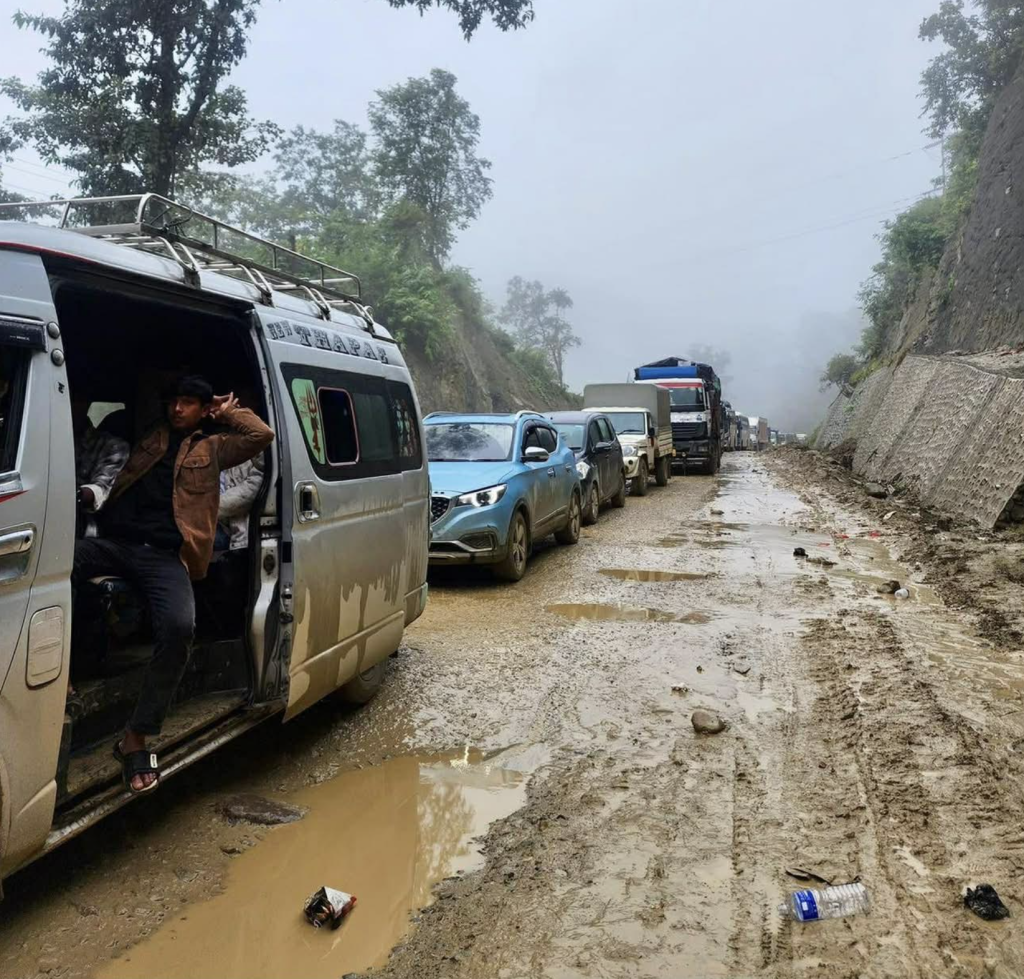
During rainfall, vehicles often struggle to move through muddy road sections. Traffic jams can last for several hours, especially when landslides block the road or when vehicles become stuck in unfinished construction zones. Traveling at night becomes even more dangerous due to poor road conditions and limited visibility (Paudel, 2026). Public transport drivers and freight transport operators face additional economic burdens. Longer travel times increase fuel consumption, raise vehicle maintenance costs, and delay goods delivery. For many drivers, traveling through Daunne during the monsoon season is considered a high-risk journey. Emergency situations are particularly concerning. Ambulances and emergency service vehicles often face delays during traffic congestion, which can directly affect health and safety outcomes.
I personally experienced the situation on December 30 while I was returning home to Bardaghat from Kathmandu. I reached Dumkibas at around 1 PM, but it took me another 13 hours just to cover Daunne road section, and I finally arrived in Bardaghat at 2 AM. During this time, several passengers of the bus abandoned bus and walked toward Bardaghat. It highlights the challenges faced not only by travelers like myself but also by all road users on this route, emphasizing the urgent need for timely project completion and better traffic management.
Challenges Faced by Local Communities
While travelers experience temporary inconvenience, local communities living near the Daunne road construction area face long-term environmental and economic impacts, as construction has become a permanent part of daily life. During dry seasons, dust pollution affects air quality and public health, while during the monsoon season, mudslides and slope instability increase disaster risks for nearby settlements. Construction activities can also disturb natural drainage systems, increasing the risk of localized flooding.
Local businesses are heavily affected, roadside shops, hotels, and small service providers depend on highway traffic. When roads are blocked or traffic flow is reduced due to poor road conditions, local economic activity declines significantly.
A significant concern is the limited response of local authorities to these challenges. While some minor measures, such as clearing small blockages or placing up warning signs, have been implemented, there is no systematic long term mechanism for addressing community grievances. Many residents report that construction decisions are made without consultation, leaving them to face environmental and economic consequences on their own. Local governments have not consistently monitored contractor performance or coordinated effectively with the Department of Roads to prevent hazards or respond to complaints. This lack of proactive oversight reflects an accountability failure: authorities are not fulfilling their responsibility to safeguard residents’ welfare, and public infrastructure projects risk imposing disproportionate burdens on the very communities they are meant to serve (Paudel, 2026).
Governance and Coordination Challenges
The prolonged delay in Daunne road construction reflects broader governance challenges in Nepal’s federal system. National highways are mainly managed at the federal government, but their impacts are felt most acutely at the local level. Provincial and local authorities often have limited authority to influence project execution, leaving them unable to enforce standards or proactively address emerging issues.
Coordination is weakened by fragmented responsibilities across multiple level: environmental clearances, utility relocation, and material extraction require approvals from different offices, often with overlapping or unclear jurisdictions. Technical and administrative capacity at provincial and local levels is limited, and monitoring mechanisms are insufficient, allowing contractors to proceed without strict oversight.
Accountability is diluted: federal agencies are formally responsible for oversight, but local governments are expected to manage public complaints without real authority to influence project decisions. This gap in responsibility creates a situation where no single level is fully accountable for ensuring timely completion, enforcing standards, or mitigating risks. The Daunne case shows that development is not only about funding and construction contracts, thus it requires effective multi-level coordination, transparent monitoring, and clear accountability across all levels of government.
Development Conflict and Citizen Trust
When development projects face repeated delays and create daily hardship, public trust in governance systems can weaken. Citizens may begin to question whether development projects truly prioritize public welfare. In the Daunne case, the road expansion project was meant to improve mobility and safety, yet for many, it has become a symbol of slow implementation, inefficiency, and governance inefficiency. Development conflicts like this occur when national development goals do not align with local realities. When communities are excluded from decision-making, exposed to environmental and economic risks, and unable to hold authorities accountable, social tension can emerge instead of public benefit.
If governance failures persist, the impacts on citizen trust can be long-lasting. Communities may lose faith in the ability of authorities to deliver basic services, potentially leading to protests, legal disputes, or social unrest. Over time, this erosion of trust can undermine not only specific projects like the Daunne road but also broader development initiatives, weakening the legitimacy of governance structures and limiting the government’s capacity to mobilize support for future infrastructure or social programs.
The Way Forward: Improving Development Governance
The Daunne road case highlights the need for more effective and accountable infrastructure governance in Nepal, particularly in environmentally sensitive areas.
Development planning must integrate detailed geological and environmental assessments, considering slope stability, rainfall patterns, and disaster-prone zones to inform road alignment, drainage, and slope protection measures. Monitoring and accountability mechanisms should be strengthened through real-time project tracking, transparent reporting, and independent audits of contractor performance, with consistent enforcement of penalties for delays, substandard work, or non-compliance with environmental standards. Coordination between federal, provincial, and local governments must be clarified through joint task forces with clearly defined responsibilities, streamlined approval processes, and a single accountable authority to oversee execution and liaise with all stakeholders. Finally, provincial and local governments require capacity-building programs in project management, environmental risk assessment, and contract supervision to effectively monitor projects and enforce accountability. By adopting these measures, Nepal can move from reactive problem-solving to proactive, transparent, and coordinated development governance, ensuring infrastructure projects deliver national benefits without disproportionately burdening local communities.
Conclusion
The Daunne road section is more than a delayed construction project, it reflects deeper governance, coordination, and development challenges in Nepal. While infrastructure development is essential for economic growth, it must be implemented in ways that protect community safety, environmental sustainability, and public trust.
The experience of Daunne shows that development success is not only measured solely by project completion, but by how effectively projects enhance the daily lives of affected communities. If governance systems can learn from such cases, future infrastructure projects can become more resilient, accountable, and community-centered.
References:
- Karki, S. (2025). Narayanghat–Butwal road project seeks fourth deadline extension. The Annapurna Express [online] Available at: https://theannapurnaexpress.com/story/56375/ [Accessed 10 February 2026].
- Paudel, N. (2026). Delayed Daunne road makes travel a nightmare. The Kathmandu Post [online] Available at: https://kathmandupost.com/province-no-5/2026/01/07/delayed-daunne-road-makes-travel-a-nightmare [Accessed 10 February 2026].
- Sharma, B. (2025). Butwal–Narayanghat road sees 74 percent physical progress after fourth deadline extension. Republica [online] Available at: https://myrepublica.nagariknetwork.com/news/butwal-narayanghat-road-sees-74-percent-physical-progress-after-fourth-dead-94-45.html [Accessed 10 February 2026].

Anima Singh
Anima Singh is a passionate Environmental Science professional with expertise in disaster risk reduction, environmental monitoring, and laboratory research. She is currently pursuing her Master’s in Environmental Science and serves as an Integration Leader at LP4Y, leading youth inclusion and community development initiatives. Anima has research experience with NAST and KIAS, contributing to environmental monitoring and traditional knowledge for disaster risk reduction. She combines scientific research skills with project management and stakeholder coordination to drive sustainable and inclusive impact. Skilled in GIS, field surveys, data analysis, and report writing, she is committed to advancing environmental sustainability and youth empowerment in Nepal.
